People are asking AI assistants the questions they used to type into Google. "Who does property inventory reports in Kent", "best scaffolding company in south London", "web designer near me". If the answer names three firms and you are not one of them, you will never see that in your analytics, because there was no click to record.
This is how to find out where you stand. It takes about twenty minutes and costs nothing.
Step 1: ask it, but ask it properly
Open ChatGPT and ask the question a customer would ask.
Wrong: "what do you know about [your company]". It will find you, because you named yourself, and you will learn nothing.
Right: the query with no company in it.
Who provides property inventory reports in Kent?
Best commercial scaffolding companies in south London
I need a web designer for a small business in Derby
Run each one three or four times, in a new chat each time, and ideally logged out. Answers vary between runs and personalise to your history, so one result is an anecdote. Note which firms come up repeatedly and what the assistant says about them.
Do the same in Perplexity, Google's AI Overviews and Microsoft Copilot. They draw on different things and the results differ.
Record the date. These results change constantly. A client of mine was named in Google's AI Overview for their category and later was not. Citations come and go, so a dated note of where you stood is the only way to tell later whether anything improved.
Step 2: check the crawlers can reach you
If the bots cannot read the site, nothing else matters.
Visit yoursite.co.uk/robots.txt. It is a plain text file and every site has
one, whether or not anyone meant to configure it.
OpenAI runs four crawlers, and they do different jobs. Straight from OpenAI's own documentation:
| User agent | What it does |
|---|---|
OAI-SearchBot | Surfaces sites in ChatGPT's search features |
GPTBot | Crawls content that may be used to train models |
ChatGPT-User | Fetches a page when a user asks about it |
OAI-AdsBot | Checks pages submitted as ads |
Blocking GPTBot does not remove you from ChatGPT's search results. Those
come from a different crawler. Blocking GPTBot to keep your content out of
training is a perfectly reasonable choice. If you want to be recommended,
OAI-SearchBot needs to be allowed.
Other names worth knowing in the same file: PerplexityBot, ClaudeBot,
Google-Extended and bingbot.
If your robots.txt says User-agent: * followed by Allow: /, everything is
allowed and there is nothing to do. If you see Disallow: / under any of those
names, that is deliberate on somebody's part and worth a conversation.
Step 3: use the two free tools that now report this
Both search engines have started reporting AI visibility directly, which means you no longer have to infer it from asking questions in a chat window.
Bing Webmaster Tools
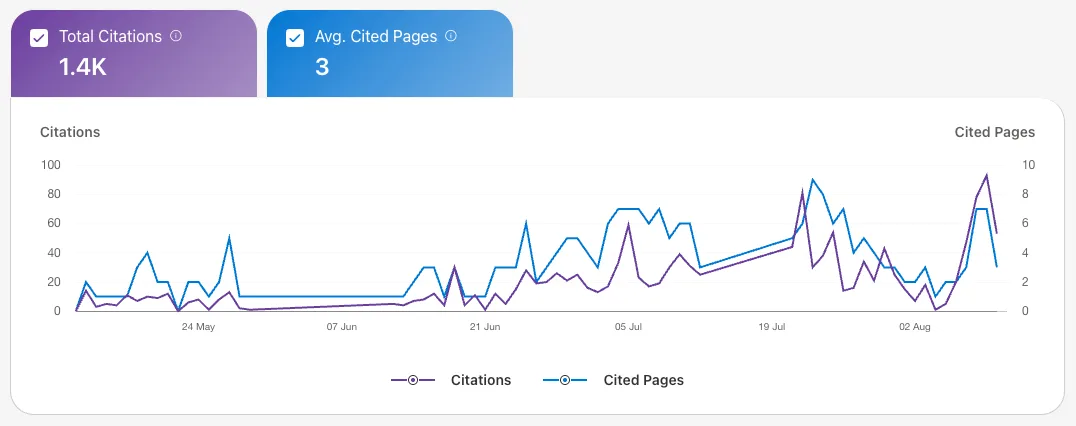
Free, about ten minutes, and most small businesses have never touched it. It now has an AI citations report showing how often your pages are cited in AI answers and how many distinct pages get cited.
On a site I run, over three months: 1,400 citations, an average of 3 pages cited, against 5,800 search impressions and 101 clicks at 1.73% CTR. So the AI citations comfortably outnumber the search clicks.
Two reasons it earns the time:
- Microsoft Copilot runs on Bing. If Bing has not indexed you, Copilot cannot recommend you.
- It reports things Google does not, in a different index with different queries.
How much ChatGPT depends on Bing's index has shifted over time, and OpenAI does not publish the detail. You will find confident claims in both directions, including blog posts calling Bing the secret to ChatGPT, and most are guesses. Set Bing up because Copilot definitely uses it and because the data is free.
While you are in there, submit your sitemap. Bing indexes far fewer small sites than Google does, and asking is usually enough.
Google Search Console, Generative AI features
Newer, still marked Beta, and easy to miss: Performance, then Generative AI features. It reports impressions from Google's AI surfaces separately from ordinary search.
Same site, same three months: 14,900 impressions from AI features, against 144,000 from search overall.
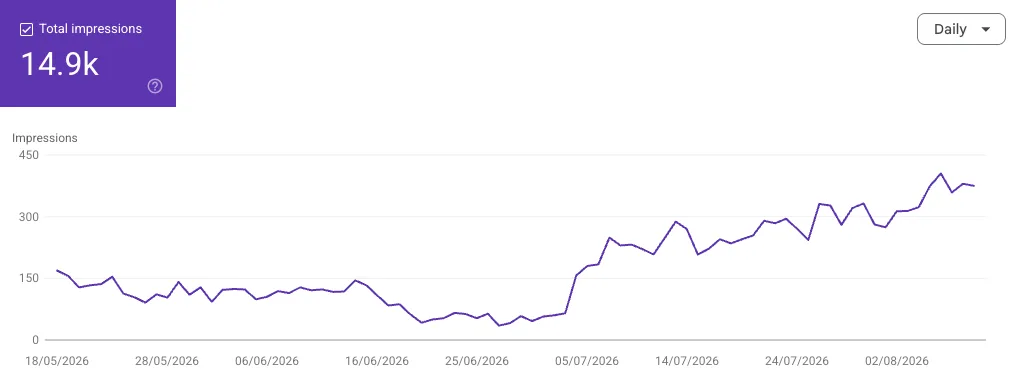
Do not read those two numbers as a league table. Bing counts citations, Google counts impressions, and they are measured differently. Together they show that both engines now surface this, that the volume is not trivial on either, and that on this site the Google side is an order of magnitude larger.
The more useful signal is the shape. On both reports the line is roughly flat through May and June and then climbs steeply from early July. Whatever is happening to AI answers, it is happening quickly, and a baseline captured now is worth more than a better one captured in six months.
Step 4: fix the thing that decides it
Assistants quote pages that answer a question directly. That is the whole mechanism, and it is unglamorous.
- Answer in the first two sentences. Anything that quotes you will quote the top of the page, not the conclusion.
- Use the question as a heading, worded the way somebody would say it.
- Be specific. "£60 a month" and "CHAS accredited" can be quoted. "Affordable" and "fully accredited" cannot.
- Keep a real FAQ, question as a heading with the answer underneath. Skip the accordion: some parsers never see the hidden text and it buys you nothing.
- Say where you work. Most of these queries are local and the area name has to be on the page in plain words.
All of that comes down to writing a page that answers the question, which is also what has always worked in search.
What not to bother with
Paying for an "AEO audit" before you have done the above. The list in step 4 is most of what any audit will tell you, and you can do it yourself this afternoon.
Chasing a citation as a metric. It appears and disappears. Track whether your pages answer real questions and whether traffic and enquiries move, because those are the things that stay put.
Blocking every AI crawler in a panic. It is a legitimate choice for training
crawlers if you feel strongly about it. Just understand you are choosing to be
absent from a channel that is currently growing, and that GPTBot and
OAI-SearchBot are separate decisions.
Questions people ask
How do I know if ChatGPT can see my website?
Check robots.txt for OAI-SearchBot, then ask ChatGPT a question your site
should answer and see whether it cites you. If it cannot find you at all when
asked directly by name, it has not indexed you.
Does blocking GPTBot stop me appearing in ChatGPT?
No. GPTBot is the training crawler. Search results come via OAI-SearchBot,
which is a separate user agent and a separate decision.
Is Bing Webmaster Tools worth setting up?
Yes. It is free, it takes ten minutes, Copilot depends on Bing, and it shows query data Google does not. Whether it affects ChatGPT specifically is less clear than most articles claim.
How often should I check?
Monthly is plenty, and note the date every time. Results move on their own, so a single check tells you almost nothing without something to compare it to.
Does Google Search Console show AI traffic?
Partly. Performance, then Generative AI features, currently in Beta, reports impressions from Google's AI surfaces separately. It is impressions rather than citations, so it tells you that you were shown, not that you were named.
Can I pay to be recommended by ChatGPT?
Not for the organic answer. OpenAI does run an ads crawler, OAI-AdsBot, which
checks pages submitted as ads, so paid placement is a separate thing from being
cited in an answer. Anyone offering to buy you into the organic recommendation
is selling something that does not exist.